
http://www.lacitybeat.com/article.php?id=5604&IssueNum=208
Weird Scenes Inside the Goldmine
How slumlord siblings trashed the iconic Morrison Hotel and how
tenants fought back
~ By RON GARMON ~
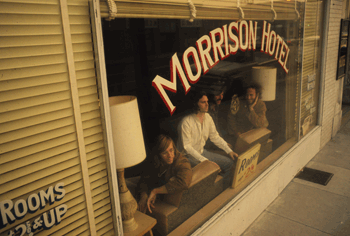 |
| Photo by Henry Diltz |
 969 was the year of Jim Morrison’s
celebrated public obscenity in Miami, during which hundreds of flashing
cameras failed to record the instant at Dinner Key Amphitheater when the
singer flashed what legend suggests was a larger-than-average penis. The
singer’s self-destruction paced that of the band he fronted as the Doors’
latest release, The Soft Parade, softly imploded. A Robbie Krieger
art project graced by his still-rousing number one hit “Touch Me” and some
of Jim’s best sloe-eyed poetics on the title track, the band’s fourth album
was a high-gloss misfire that puzzled their vast, vociferous fanbase.
Morrison, a man with seismically shaky judgment in every other matter, then
took over musical direction of the Doors and led them back to greatness.
969 was the year of Jim Morrison’s
celebrated public obscenity in Miami, during which hundreds of flashing
cameras failed to record the instant at Dinner Key Amphitheater when the
singer flashed what legend suggests was a larger-than-average penis. The
singer’s self-destruction paced that of the band he fronted as the Doors’
latest release, The Soft Parade, softly imploded. A Robbie Krieger
art project graced by his still-rousing number one hit “Touch Me” and some
of Jim’s best sloe-eyed poetics on the title track, the band’s fourth album
was a high-gloss misfire that puzzled their vast, vociferous fanbase.
Morrison, a man with seismically shaky judgment in every other matter, then
took over musical direction of the Doors and led them back to greatness.
Morrison’s evolving bluesman persona replaced his shucked-off skin as the Lizard King, grew him a hairy face, forgave a swag belly, and lent context to his increasingly stewed and wiggy behavior. Tracks for an untitled fifth album were recorded at Sunset Sound late in the year, the vivid aural jottings of a megabuck maudit turned blue and skanky. It was a manic, jaggedly brilliant croon at the devil that was without a title when rock ’n’ roll photographer Henry Diltz came into the story.
“The Doors called my partner, Gary Burden, and I about doing their next album cover,” Diltz says, settling into an oft-told story, one a bit star-crossed even for Woodstock’s official photographer. “We asked, ‘Do you have a title? Any ideas?’ and no, they didn’t. Ray Manzarek spoke up and said, ‘My wife Dorothy and I were driving downtown the other day and we saw this little hotel called the Morrison.’ We drove down there and took a few shots with just Jim and Ray. We walked into the lobby and they sat behind the window and we shot.”
This found-money intersection of the decaying “gentleman’s hotel” on 1246 S. Hope St. (on the corner with Pico) and the last name of the lead singer of L.A.’s most decadent rock act was entirely too good to pass up. By January 1970, downtown was well into a post-WW II decline of its own, attested by the bleakly deco “ROOMS From 2.50” sign just below a recently shaved Jim on the cover of Morrison Hotel, Diltz’s best-known photograph.
“A couple of days later we brought the whole band down there,” Diltz goes on. “We parked the VW van and walked in. I told the guy at the desk we were going to take a few photos and it would take but a few minutes and he said we couldn’t without the owner’s permission and the owner wasn’t there. I thought, You’re kidding! It was a transient hotel and it was empty! I saw him leave the desk and get in the elevator. Right on the cover, you can see the lit elevator numbers right under the ‘son’ in ‘Morrison.’ I said ‘Quick you guys, run in there!’ They jumped right behind the windows and hit their places without shuffling and I shot. I shot one roll of film, starting close to the window, and then I backed across [Hope] street with a telephoto lens. So we finished the whole thing in about five minutes and the guy never saw us. We pulled it off though, like a guerrilla photo shoot.”
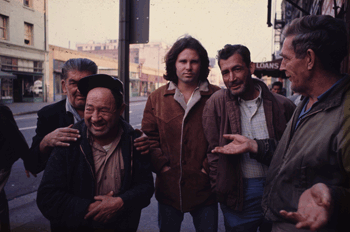
Luckily for the album’s conceptual shape, the outing didn’t end there, as Diltz remembers. “As soon as we walked out of that place, Jim said ‘Let’s go get a drink,’ and we went to Skid Row, which I believe was on Sixth Street, where it was all bars and pawnshops. We were trying to pick one and on the corner, we see ‘Hard Rock Café’ and we went in, had beers, and talked to the old winos in there. They loved Jim because he wanted to hear their stories.” Henry snapped pics of the band lounging in the Café s Iceman Cometh ambiance. The bar also lent name to side one on the original LP. “Hard Rock Cafe” is a roughneck boozy suite, commencing with the sweat-haunch carnality of “Roadhouse Blues,” piling into the blissed-out proto-punk of “Waiting For the Sun.”
On “Peace Frog,” Jim recites a butcher’s bill of: “Blood stains the roofs and the palm trees of Venice/Blood in my love in the terrible summer/Bloody red sun of fantastic L.A.” – heaping spastic malediction on the town he was soon to leave. “Ship of Fools” ends the side with a cheery meditation on the end of all us human flotsam and jetsam. Side two is “Morrison Hotel,” a series of boozy howls (“Land Ho!”) followed by daintily lapped puddles of nectarous sweat (“The Spy”) and naked-hippie wonderama (“Queen of the Highway” and “Indian Summer”) giving a last phantasmal flicker of romance before “Maggie M’Gill” offers a dirty-blues invocation of a memorable piece of ass. This was barbed and funny and scabrous music for a new, decidedly less hopeful decade.
Morrison Hotel was one of the great reversals of fortune in rock history and a template for the overdriven L.A. Woman, a gloriously lumpy finale to the Doors’ career. Jim died in a Paris bathtub in 1971 under circumstances not so much mysterious as inevitable. “The last two [albums], we knocked out in a few weeks each, with the idea being Fuck the mistakes, go for the feeling,” Doors’ drummer John Densmore tells me, “like we did in the garage.” It turned out to be a fateful confluence of events for many.
“When that album came out,” Diltz remembers, chuckling, “they got a call from London, from some entrepreneurs who wanted to use the name for a chain. That made their empire. That day was quite an astrological day in someone’s life. Out of all the covers I’ve done, that’s the one people remember immediately. When young kids ask me which covers I’ve done, they don’t know the Eagles or Jackson Browne, but on Morrison Hotel, it’s d-u-u-ude!”
I’m the Crawlin’ King Snake
And I rule my den
Yeah, don’t mess ‘round with my mate
Gonna use her for myself
Built for Belgian-born tycoon Victor Ponet, the Morrison Hotel was designed by the master architectural firm of Morgan, Walls & Morgan and run up by builder F.O. Engstrum for about $95,000 in 1914. Though that firm’s career was brief (1910-23), it left an enduring mark on the look of downtown L.A., with still-standing designs like the Globe Theater, the Arcade Theater, and the Hass Building gracing South Broadway and the dramatic Santa Fe Building dominating its neighbors on S. Los Angeles and W. 6th Street. The partnership evolved into Morgan, Walls & Clement, which soon played a pivotal role in the evolution of L.A. art deco architecture, designing both the Wiltern and the Mayan theaters. The four-story Morrison is done in a style called “Utilitarian/Applied Decoration” and is cited as a “stylistic and representative example” of such by the L.A. Conservancy, which deemed it “Worthy of Note” in 1981.
The settled, genteel decay that made the Morrison Hotel the visual hook for the Doors’ dirty daydreams accelerated into something gamier with time. Over $18,000 in alterations made to comply with fire safety ordinances in 1974 failed to prevent a 1978 fire that cost a different landlord about the same amount in repairs. A third spent $369,000 on a 1988 seismic retrofit to bring the building up to code compliance. The hotel (and adjoining shops) seems to have changed hands frequently, with the building’s present owners, Hope-Pico LLC, acquiring the property in 1997 along with the adjoining parking lot on Pico sometime later. They paid slightly over a million dollars for what was then a neglected 111-unit hotel in an increasingly blighted part of the city. The place possessed a gilt-edged name and, with the opening of Staples Center in 1999, a star-making neighbor. The latest attempt to “revitalize” downtown came shortly after and several “funky” old buildings without the value-added historical cachet of the Morrison began to sell for impressive sums, to be cut up as condos and “lofts” for the arty upper-middle class.
Hope-Pico LLC is headed by Henry and Sauli Danpour, local real-estate barons who also tended affairs at Phoenix Mortgage Corporation, a family-run concern founded in 1983 by Sauli that held, by its own estimate, “over 15 different companies, which provide more than 500 fully functional rental units.” As an example of Phoenix’s commitment to “community relations,” the corporation rents these units “at below market prices to low income families who might otherwise not have the opportunity or the means to have a roof over their heads.”
Or so read the smarmy flackery on Phoenix Mortgage’s now-defunct website. From all reports, life at the Morrison by summer of ’04 was a nightmare of filth, violence, malign neglect, and brute leverage, as the Danpour brothers seemed bent on emptying the hotel of the working-class people and state aid recipients who inhabited it.
Cancel my subscription to the Resurrection
Send my credentials to the House of Detention
I got some friends inside
“Months before, we’d actually entered the building to do an outreach. Tenants came to us and said they were being offered small sums of money to move out of the building and others said they were being locked out and others came to us saying they were being evicted, tenants with all kinds of issues.” I’m talking with Davin Corona, director of organizing at SAJE (Strategic Actions for a Just Economy), a busy no-frills office in the industrial maze near USC. “When we heard this was happening, we figured, well, this is one of the only working-class housing buildings left in this area and we should try to preserve it.”
SAJE is a handful of activists pursing a program of “urban land reform” – in the form of affordable housing, a citywide tenant’s union, and iron-toothed justice for slumlords. Soon, Morrison tenants began arriving “about five to seven in a week. We knew something was going on,” says Corona. “It was a slum building, but this was the first time any of the tenants had come to us. Immediately after the owner started harassing tenants and evicting them, that’s when tenants started coming to us as a last resort. We met the tenants away from the building, talked with them about basic tenant rights and what they wanted us to do for them. What it came down to, is they wanted us to door-knock the entire building, but they felt like management wouldn’t let us in so we had to do it on a Sunday, when management wasn’t around. So on Sunday we did the entire building. There were about a hundred units and most of the building was occupied. We go in later and the building’s half-empty. In a one-month span, people were persuaded, intimidated, or given small sums of money to leave – illegally small amounts that they shouldn’t have been giving.”
Remaining tenants stayed to bring suit against the landlord, with several dozen signing on for Ramirez v. Hope Pico Company, LLC and paying their rents into escrow accounts. Court documents and related depositions form a clean, white paper heap of vermin, despair, and sickness, with each tenant giving variations on the same squalid story. The elevators worked irregularly, common areas and corridors were unlit, common bathrooms stank from defective plumbing, and roaches were everywhere, leaving surfaces streaked black with their shit. No food was safe and the hotel’s management insisted to all who complained that insect eradication was the individual tenant’s problem, not the building’s. Documents detail the impressive, hopeless expenditures the poor of the Morrison pinched from their own tiny resources in combating the roaches.
The gentleman in one unit told of rats big enough to make galloping sounds as they ran down long, dark hallways and a frightening increase in the number of drug addicts in common spaces, as building security began to deteriorate early in the decade. The children began to suffer from headaches and vomiting – symptoms associated with conditions in the building, especially peeling lead-based paint. A man on the fourth floor, wheelchair-bound after a gunshot wound to the leg, had to defecate on a rubber mat on his bed, since there was no handicapped-accessible, working toilet for him to use. He reported waking up to roaches crawling on his bloody wounds, and he later lost his leg due to gangrene from an advanced fungal infection.
“Imagine an old, slummy, dingy, dark, old-school hotel,” remembers Davin, his face grim, “fifteen doors to a hallway. There were lots of people living in the building. The outside didn’t look like much, but in the inside, it was bustling with people. The place looked held together with tape and bubblegum. You’d talk to a tenant, come out into the hallway and brush cockroaches off. You walk through a unit where the roof was leaking and the management fixed it by placing a trash bag over the crack that drained into a bucket. And there’s this really bad stench and the eeriness of mostly dark hallways. The bathrooms were disgusting, you would not want to step foot in that. When it got dark, folks wouldn’t leave their units because they’d allow random transients to walk through the building. People shooting up in the hallways, people having sex in the hallways.”
“Besides not wanting to repair basic things, like the drainage seeping through pipes and coming up on the floor, the other thing was they hired two armed security guards that started harassing the African-American tenants, the divide-and-conquer thing. They started treating the Latino tenants with at least a certain respect. They would make racist comments and there was a lot of tension there. With the Latinos, they used immigration as a harassing tactic. That did get a couple of folks to abruptly leave the building without relocation money. The main plaintiff in the case, the one we were working most closely with, well, someone in the building, no one knows who, got one of her kids and tried to strangle him to death with a guitar string in the restroom. During this point, we were negotiating with the owners and after that, she just wanted out. We almost lost the case after that, because tenants were just scared.”
Nor was hotel staff anything like what you’d find at the Biltmore. The building’s guards (hirelings from a well-known local goon-works) reportedly drank on duty and there were accounts of pilferage from tenants by people with access to master keys. The handyman believed anyone who expected privacy in the bathrooms was “crazy” and loose tiles on the floor were only a danger if one stepped on them. The building’s on-site management was left to a couple who regularly locked residents out and withheld their mail. The pair also had a menacing pit bull dog that was used as a conversational prop. The handicapped man in 423 complained that the couple would chase his visitors away. On weekends, management would lock up the office and leave the building open to any who cared to walk in.
Meanwhile, the Morrison was being listed as for sale on Grubb & Ellis, priced at $8 million, with a scheduled gross income for 2005 at $1.36 million.
SAJE organized, picketed, and raised hell against Phoenix Mortgage, with staffers putting together a list of other companies and LLCs controlled by the Danpours, detailing mass evictions and building code citations in rental properties elsewhere in town. John Densmore of the Doors became involved and attended a few actions. The publicity was appalling and a 2004 city inspection yielded over 100 code violations. City Attorney Rocky Delgadillo was less than pleased when the brothers avoided jail time early last year in a widely covered criminal prosecution. “Henry and Sauli Danpour gambled with the lives of their tenants and won,” read the city attorney’s statement. “The financial penalties imposed are significant, but the only way to bring an end to this sort of willful disregard of our housing laws is to send slumlords to jail.” They drew a suspended sentence of 120 days in county, five years probation, paid over $120,000 in fines and costs, and were ordered to control vermin and assist in relocating remaining tenants.
The Danpours would go on to lose $1.25 million in tenant settlements in Ramirez later that summer. “We’re not supposed to talk about the amount. It was past the one-point-million-dollar mark,” said Corona. “Depending on the length of time lived there and injuries suffered, there was a formula created for tenants to get a piece of that money. I understand most tenants went home with well under a hundred thousand each, which isn’t much when you consider what living in a rent controlled unit is worth. One family actually bought their own home, another garment worker is running their own garment business.” Brother Henry reportedly collapsed in the courtroom when the verdict was announced and an ambulance was called.
Tell you ’bout the world that we’ll invent
Wanton world without lament
Enterprise, expedition
Invitation and invention
The Morrison Hotel now stands empty, boarded-up and liberally festooned with NO TRESPASSING warnings. All other signage has been removed. The estimable Ed Huang of the Community Redevelopment Agency of Los Angeles says the owners of the building made a routine inquiry into demolishing it around October of last year, but the legal and procedural hurdles are daunting. The building’s exterior south and west facades, with their terra-cotta decorations and glazed brick, mark it as stylistically significant architecture; and the interior stairwell, railings, and molds have withstood time and neglect to retain period integrity, according to a 2005 survey memo supplied by CRA/LA. There was talk of buying the hotel and converting it into a home for old musicians, but nothing’s come of it.
This battered and elegant structure is culturally unique, in stark contrast to the accumulated foul karma of the brothers Danpour. Whatever their offenses as landlords, Sauli and Henry appear to rank as businessmen alongside the doomed commercial wizards of Charles Dickens. Self-screwed to the walls of this white-elephant property, their hopes for that sure-thing mega-profit recede a little further all the time. The City Council’s moratorium on loft conversions still has some months to run and the future of the Morrison might rest with Mayor Antonio Villaraigosa’s billion-dollar “affordable-housing” bond on this November’s ballot. In the absence of new city policy, Hope-Pico LLC could wind up paying property taxes on an empty building until the 50-year anniversary of Henry Diltz’s photos in 2020 makes it eligible for inclusion in the National and California Registers. The place deserves a better fate, one that serves the housing needs of Angelenos in a fairer way than simple vulgar gentrification.
When this city finally gets around to civic recognition of its greatest-ever rock ’n’ roll band, there won’t be many physical traces left to celebrate. Jim lived out of WeHo hotel rooms and the London Fog, the Sunset Strip venue where the Doors did their first residency, is long since gone. Critical assessments of the band’s catalog waver in the manner of cultists everywhere, but no one denies the staying power of rock as art nor the preeminent place of the Doors in its all-time annals. Those creepy, ever-new sounding songs, the slick, intricate, West Coast bombast and Morrison’s widescreen poetics were inspired by (and leveled at) Los Angeles, a city the band mined of its alienation and turned into unforgettable pop art. If the city were to recognize the Morrison Hotel for the accidental treasure it is, then the long, torturous process of liberating the building from its owners may finally commence.
(thanks, Pat and David my son)
photos taken on May 5, 2007 ... also links to earlier photos
return to Ida's LA Woman Confidential home page
for more Doors news and reviews