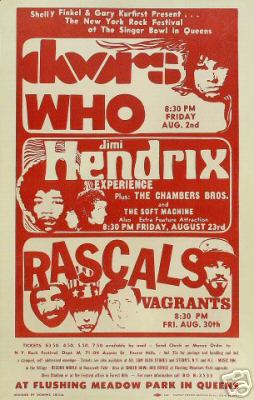
Concert-goers were still arriving around 8:30 PM when Kangaroo took the stage. The scant audience seemed to have little patience with them. Kangaroo never made a record, and thus, posterity has no way of assessing this reaction. Perhaps, regardless, it should surprise no one, in light of that night's eventual outcome.
The Who, full of youthful arrogance and absolutely determined to make a lasting impact on American rock music fans, insisted from the get-go that none of the Doors' equipment -- pre-positioned on stage in the interest of saving time -- would get in their way. Their demands were recognized. The set was vintage Who, an explosive mix of windmilling arms and twirling microphones. And LOUD. Pete Townshend brandished a candy-apple red Fender Stratocaster with a white pickguard (ironically his guitar of choice from 1989 to the present, though it is now called by Fender an "Eric Clapton Model," and Townshend no longer removes or ignores the whammy bar, at last admitting his long-disavowed though in fact deepseated admiration for Jimi Hendrix). Keith Moon played his trademark psychedelic "Pictures of Lily" drumkit. The rotating stage, however, began to slow due to a mechanical malfunction, and limited by 1968 PA technology, consequently the spiralling sound echoing off of the Singer Bowl's confines created a bizarre effect for those not directly facing the amplifiers. The songs, in sequence, were as follows: "Heaven And Hell"; "I Can't Explain"; "Summertime Blues"; "Fortune Teller"; "Tattoo"; "A Quick One (While He's Away)" [Actually a 'mini-opera' of several interconnected short songs from their second LP -- the Who had just announced plans to begin recording what would become 1969's TOMMY]; "Magic Bus"; "Shakin' All Over"; and "My Generation."
As was customary for them at the time after closing with "My Generation," Townshend and Moon demolished their instruments. It was well that the Doors had made allowances for the Who's wishes: In spite of having minimized pre-show set-up, some of the Doors equipment nevertheless ended up damaged by the Who's violent extravagances. This in turn caused further delay, ratcheting up tensions amongst the already penned-up, sweating crowd. For the Who's part, they exited the stage to join the audience as fans themselves, eager to see what the headliner band -- one of the most popular in America and Europe -- might have to offer.
From the start, Pete Townshend recalls that he was both "fascinated and appalled" by the behavior of Doors frontman Jim Morrison. Reputedly, he punched a fan in the stomach who attempted to get near him while mounting the stage, then stood passively while one of his bodyguards beat another one up. Morrison was laughing. He was also incredibly intoxicated and in a mood to cause trouble. For Jim Morrison on this night, the Singer Bowl was the perfect environment.
The Doors opened their set with "Back Door Man." This was followed by "Five To One"; "Break On Through (To the Other Side)"; "When the Music's Over"; "Wild Child"; "Light My Fire"; and "The End."
During the entire performance Morrison repeatedly screamed, yelled obscenities, staggered and fell down, balanced on the edge of the stage and taunted the police. His obvious though unspoken desire was to provoke a full-scale riot, which he easily succeeded in doing. In addition, the stage finally stopped rotating altogether, causing a general melee rush to the front in order to see the band. 1968 had already been a vicious year between the NYPD and the youth counterculture with a multitude of anti-Vietnam War protests that intensified the ideological divide. The Singer Bowl came apart. Cops chased hippies into the stands swinging nightsticks. People began picking up metal chairs and swinging them at each other (Pete Townshend saw a girl near him get clobbered with one, resulting in a huge cut down the side of her face replete with a freshet of blood. Upon returning to England after a few more gigs at stateside, as the recording of TOMMY got underway, Townshend penned a song immortalizing the incident, and Morrison's performance, which also found it's way into the opera, "Sally Simpson."). Chaos prevailed. The Doors entire performance, the riot notwithstanding, was filmed and later edited by Morrison with assistance from a few buddies into FEAST OF FRIENDS -- today available as part of the Doors Boxed DVD Set.
At this point, with the Doors' show over, the audience scattered to the four winds, as the riot slowly dissipated into the streets of Queens. In some instances, the police gave chase. Many people were injured, some seriously. And the volatile time of the late 1960's marched on. Remarkably, none of that month's future shows at the Singer Bowl were cancelled. Later performances of the New York Rock Festival included the Jimi Hendrix Experience; Janis Joplin's first band, Big Brother And the Holding Company; the Rascals (no longer calling themselves the "Young Rascals"); and the Vagrants (who, while not significant in and of themselves, did have future Mountain guitar legend Leslie West -- also a future friend of Pete Towhshend's who played lead guitar on an early version of the Who's "Love Ain't For Keeping" available on the CD version of the Who's ODDS & SODS album, released in 1998).
return to Ida's LA Woman Confidential home page
for more Doors news and reviews