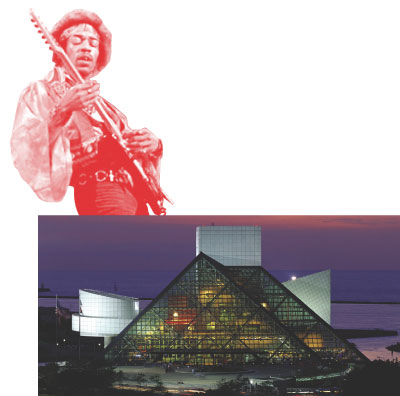
Cleveland...Rock City?
|
If “Hail, hail rock and roll” (a line from Chuck Berry’s “School Days”) isn’t the official motto of Cleveland, it should be, on tourism grounds alone. Since 1995, when the Rock and Roll Hall of Fame and Museum (216/781-7625; www.rockhall.com) opened there, the number of visitors to the city once known as the Mistake on the Lake has more than doubled, to about 10 million a year. Not since Elvis moved to Memphis and Liverpool gave birth to the Fab Four has rock music done more to put a city on the map.
To many, Cleveland was an odd choice for such a venue. No marquee stars call it home. The city only has claims to Eric Carmen, Tracey Chapman, Michael Stanley, Pere Ubu and Joe Walsh—and he only attended college there. It has never been identified with a sound, like Nashville, Detroit or Seattle. The Who never even trashed a hotel room there.
Cleveland is home of the Rock Hall, as locals call it, because it came up with enough seed money to impress the New York-based Rock and Roll Hall of Fame Foundation, which needed a place to hang the plaques it had started awarding to the musical elite. Also in the city’s favor: Cleveland DJ Alan Freed is credited as the first person to use the term “rock & roll” to describe the music that now encompasses recordings by everybody from the Dominoes, Ruth Brown and Fats Domino to the Stones, Ozzy Osbourne and Creed. (An exhibit devoted to Freed will be on display through May 18.)
Most people don’t go to Cooperstown to look at plaques; they go to see the bats, balls, gloves and uniforms of the stars. Same with the Rock Hall. The Hall of Fame exhibit, with its collection of songs, etched-glass signatures and videos of induction ceremonies and career highlights, more than does justice to its inductees. But it’s The Stuff that mesmerizes the crowds: the instruments, costumes, stage props and personal effects that make up the museum.
If rock has been the soundtrack of your life, then the Rock Hall is your Disneyland. It might seem more like your father’s Disneyland if you’re younger than, say, 35, shun Classic Rock, and couldn’t relate to the obsessive record store geeks in the film High Fidelity. That’s because most of what’s found here plays to Baby Boomers, and anyone else convinced that the most important music ever made was recorded between the mid-50s and the mid-70s.
This partly has to do with timing: Boomers were coming of age when rock & roll was born. How else do you account for the lopsided results of the Top 10 Favorite Songs poll conducted at the Rock Hall two years ago? Except for Chuck Berry’s “Johnny B. Goode,” all the winning songs were recorded by artists whose careers began in the 60s. Boomers may be losing their grip on the Rock Hall, however, if recent elections are any indication. The most recent two classes of incomers were dominated by punk and post-punk bands, including The Ramones, Talking Heads, The Clash, Elvis Costello & the Attractions and The Police.
The most interesting stuff in the museum relates to the classic rockers, though. Jim Morrison, the Doors’ late lead singer, must have lizard-king-crawled in his grave the day the Rock Hall opened an exhibit that includes his Cub Scout uniform, report cards and childhood drawings. I guess nobody took Jim seriously when he sang, “When the music’s over/Turn out the lights.”
If gawking at Morrison’s Cub Scout necktie or Madonna’s bustier isn’t your idea of a good time, don’t fret, because much at the Rock Hall favors music, as opposed to celebrity. The film Mystery Train skillfully shows how blues, gospel, country and ethnic folk music came together to become rock. “One-Hit Wonders” spotlights great records made by artists who never were heard from again. It’s an ironic commentary on the serendipity that is all but lost in a business that has become calculating. Bands like the Syndicate of Sound may have never had another hit (“Hey Little Girl,” in their case), but as Neil Young sang, “It’s better to burn out than fade away.”
Then there’s the Jimi Hendrix Theater, which blasts you with 15 minutes of the most mind-blowing (a term worth dredging up for this guy) rock guitar licks ever played—in surround sound.
If the thought of seeing one of Jimi’s Stratocasters makes you want to strap on your air guitar and crank up the karaoke machine, then set the cruise control to 65 and head west on I-80. It’s only seven hours to rock & roll nirvana. That’s a transcendent state of bliss, by the way, not a rock band from Seattle.
Peter Crescenti is editor-in-chief of Car & Travel.
August 7, 2006
return to Ida's LA Woman Confidential home page
for more Doors news and reviews