http://worldspaceasia.com/nuketohtml.php?filnavn=files/michelle_campbell_interview.htm
MICHELLE CAMPBELL interview
| "I often had the feeling that we were at a party in someone's apartment and that the surrounding graves were like big sofas or armchairs." |
What made you choose Morrison as a subject in the first place? And did you have a clear idea about the focus of your project when you started out? |
Pics: Credit and
copyright Michelle Campbell |
Michelle:
I bought the Doors' first album in 1967, I liked their music, and I bought
all the other albums. I still like their music, but I did this project
because I am an artist, a photographer, and this is a very interesting
project for me, visually and sociologically. I see this as an example of
how important media is in our daily lives, and how it can influence people,
even create new religions. I see a trip to Morrison's grave like an old
fashioned pilgrimage, some people go and experience some sort of
transformation, it changes the way they think about the world.
Indeed, just listening to Doors music everyday transforms people, in that it gives them some sort of framework for their daily lives. People tell me stories all the time about how the music helps them get through the day, is "their special friend", if you will. They tell me how after a trip to Jim's grave they have been inspired to change their lives, quit a job they don't like, do painting, music, write, whatever, taking Morrison as their example. It was quite by accident, in that I chose Paris and Père Lachaise, and Jim just happened to buried there. Being a fan, I would visit his grave every time I came to Paris, but I also loved to take photos in all the Parisian cemeteries. I didn't come to Paris with doing a specific project on his grave in mind, it just evolved. I wasn't clear at all about what I thought about the project, in that I came to Paris with the idea of staying only a year. I knew that I wanted to concentrate on Père Lachaise, the sculpture, flowers, etc. Every day I would go by Morrison's grave and see all the people and the meeting place that it was becoming, and I became more and more interested in that. Finally I decided to concentrate just on that. More and more people began to come and the phenomenon and I just evolved together |
| Was it easy to make a living in Paris as an expatriate teaching English? |
Pics: Credit and copyright
Michelle Campbell |
Michelle: When I came to Paris I was a university Professor in Photography. I left my job only for what I thought would be a year, with the idea of living the dream of a lot of artists, being able to concentrate on a project here. I had a residency at the Cité International des Arts, a place where artists from around the world live. I managed to live there for 2 years, but after I decided to stay on and not go back to my job, etc., I had to think of a way to make a living in a country where I don't speak the language well, and I know nothing about computers, and they don't particularly like the idea of a foreigner taking French jobs, so, in short, it was difficult, but I've made it work to be able to continue my project. |
| Do you think there are any other music icons in the same league as Jim Morrison who inspire people to change their lives, or draw these huge devout crowds ? Say Elvis for instance? |
Michelle: My interest is only focused on Jim Morrison, but I can't imagine anyone else, like Elvis, having the same effect. His fans seem to be older. Morrison is more like a rite of passage for a lot of young people, he seems to help them frame their views of life, their place... That being said, he has fans of all ages. Countless people have told me that they can't get through the day without playing a Doors album. People of all ages are writing poetry, composing music, painting, reading certain literature, whatever, because of what they perceive as the idea of Jim, the Doors, and individual freedom to do what they want in life. I really haven't heard any stories about anybody else inspiring people in quite the same way, but all artists inspire others, that's the beauty and continuation of art. |
Pics: Credit and copyright Michelle Campbell |
| What was your approach to this project as an artist and documentor? What methods do you use? |
Pics: Credit and copyright
Michelle Campbell |
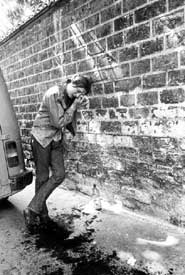
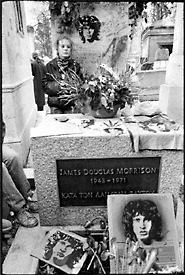
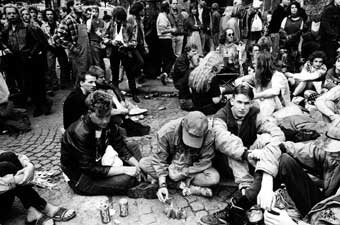
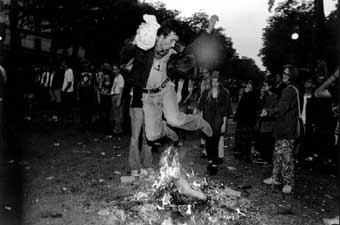
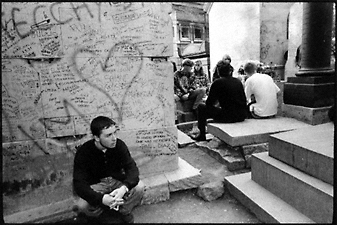
Michelle: Basically, I just went there everyday and observed what was happening, the people that would come, and I photographed them and talked to them. It was a great scene, people came from all over the world, and would listen to the music and talk, and make friendships that they would continue. I often had the feeling that we were at a party in someone's apartment and that the surrounding graves were like big sofas or armchairs. It was wonderful. I became friends with a lot of people from around the world and I would photograph them each time they visited. There were also local people that would come a lot. I think that is one of the most important aspects of this story, the sense of family that Doors fans have, especially ones that have visited Jim's grave and met others there. I am now lucky enough to be a part of that family. As for methods, I would take photos, get addresses, etc.,but I never wrote anything in a journal because I didn't know where the project was heading. I was just concentrating on the photographs. Now I want to write a book about my experiences, and most of it is in my head. I see it as a book about the idea of pilgrimage, how it enriches and transcends people, but also how media now influences our lives, and even creates our new religions and gods for us. All food for thought. |
| What are the most interesting photographs you have taken from a personal point of view? And why? |
Pics: Credit and copyright Michelle
Campbell |
Michelle:
That is a very difficult question, when you are
photographing you never know which ones are going to be interesting, and
there are so many categories, artistic, historic, meaning that the photo may
not be particularly interesting, but the person is famous. For example, I
have Greg Allman visiting, as well as Bon Jovi. I didn't know who Bon Jovi
was at first, but I knew he must be a rock star because of the expensive
cowboy boots he was wearing with his worn jeans. I've also got photos of
Danny Sugerman (Pic alongside), Ray and Robby, Ian Astbury, all important
from a historic point of view, but not interesting from an artisitic
perspective. Now that I've decided to tell the story for Doors fans I use a lot of photos that I don't think are interesting from an artistic point of view. I guess some of the ones I really love personally are of fans, quiet moments at the grave, some of their tattoos You'd be amazed how many people have Doors-related tattoos. I guess the bottom line is where I want to use the photo, and what it means to me personally, and especially to Doors fans, like special events, July 3, the day he died, or Dec 8, his birthday, or a visit by other band members or other famous people. I've got photos in all categories. |
| When you look back what are the memories that stand out? |
Pics: Credit and copyright Michelle Campbell |
![]() |
Michelle:
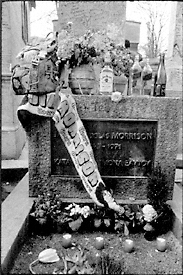
The memories that stand out are the personal stories of fans, their lives, or
special events, like 1991, when so many fans came because it was the 20th
anniversary of Morrison's death, and Stone's film had just been released. They
had to close the cemetery and sadly, a riot ensued and (there was) not very
nice behaviour by some people. I think I was tear-gassed about seven times that
day, proof that this is not a boring project! It is especially strange to be
tear-gassed to Doors music. I also saw Morrison's parents at the grave, and I
could sense how much they loved their son. The same when I saw Danny Sugerman
there for the first time, I could sense that he knew Morrison, and that he was
moved to be there, but I thought how is this possible, he's too young. I
photographed the moment and later found out it was Danny. There are also
portraits of countless fans, the expressions on their faces, the emotion of
being there near Jim, even the photos as
they leave mementos, souvenirs of their visit, etc. The whole experience of
being there and witnessing this phenomenon has been an incredible one for me.
![]() |
![]() |
Pics: Credit and Copyright Michelle
Campbell |
![]() |
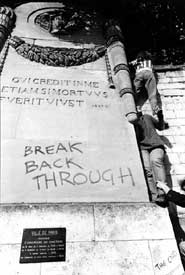
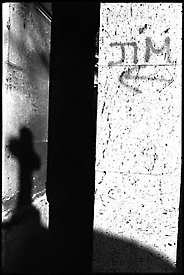
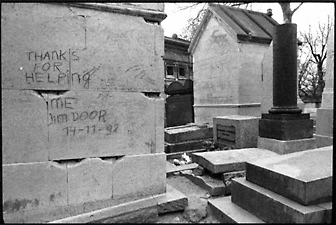
| The famous graffiti leading all the way to Jim Morrisson's grave has been wiped out... |
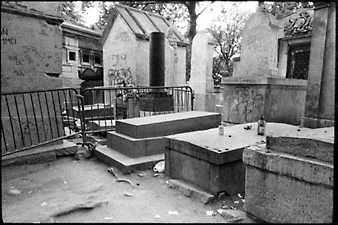
Michelle: Now there are guards there most of the time and cameras. And as of last April, there is a metal barrier around the grave, so you can't stand close to it or behind it like you used to. Because of this, the graffiti has just moved out to other parts of the cemetery. Cemetery officials plan for the barrier to be permanent.
Pics: Credit and Copyright Michelle
Campbell |
![]() |
|
Pics: Credit and Copyright Michelle Campbell |
(thanks, Stuart)
return to Ida's LA Woman Confidential home page
for more Doors news and reviews